










Parallel Paths – 3.2 Canada Leads the U.S. on Climate Policy
This section explores the implications for Canada of leading the U.S. on climate policy. It assesses environmental and economic outcomes if Canada implements climate policy while the U.S. does not.
If Canada were to implement climate policy ahead of the U.S., it would face economic impacts from its own policy. However, implementing more stringent policy in Canada, whether ahead or at the same time as the U.S., reduces the risk of U.S. border carbon adjustments. It also reduces the environmental risk associated with missing GHG emission reduction targets.
ENVIRONMENTAL RISKS
Canada’s risks of missing its 2020 GHG targets are eliminated in a Canada leads scenario. The risk of not being positioned for long-term emission reductions is also avoided, as Canadian policy would drive low-carbon investment and innovation.
ECONOMIC RISKS
If Canada were to move first and lead the U.S. in implementing climate policy in order to achieve our 2020 targets, Canadian firms would face greater costs leading to some competitiveness risks. To assess the economic and competitiveness implications of leading the U.S. on policy, the NRTEE explored scenarios where Canada’s emissions are reduced to 17 % below 2005 levels in 2020 while no emission reductions are imposed in the U.S.
Table 6 illustrates key economic outcomes under this scenario. Moving ahead of the U.S. would result in higher carbon prices in Canada than in the U.S. The Canadian carbon price to meet our 2020 target alone emerges at about $74/tonne.29 Under this scenario, Canada still experiences positive GDP growth, but total GDP in 2020 is about 2.0 % lower than the reference case, or what it would have been in 2020 without any new carbon price and climate policy. Net exports decrease by $5 billion in 2020 (29 %), suggesting competitiveness issues for emissions-intensive and trade-exposed sectors is significant. Shifts of investment also occur, as capital seeks higher returns in the U.S.

Competitiveness risks for Canada of leading are concentrated in the vulnerable emissions intensive and trade-exposed sectors. Figure 12 shows impacts on GDP growth on these key Canadian sectors relative to the reference case. Resource extraction sectors again show the biggest impact, though it is important to note that all sectors that were forecast to grow in the reference case continue to grow under the Canada Leads scenario. The oil sands sectors in particular are still forecast to grow at rates of 6–7 % per year under this scenario,31 well above the national average economic growth rate of 1.9 %. The net effect of the Canadian policy on national economic activity, however, would lower Canadian GDP further, and include some additional regional risk given the concentration of oil and gas in Western Canada.
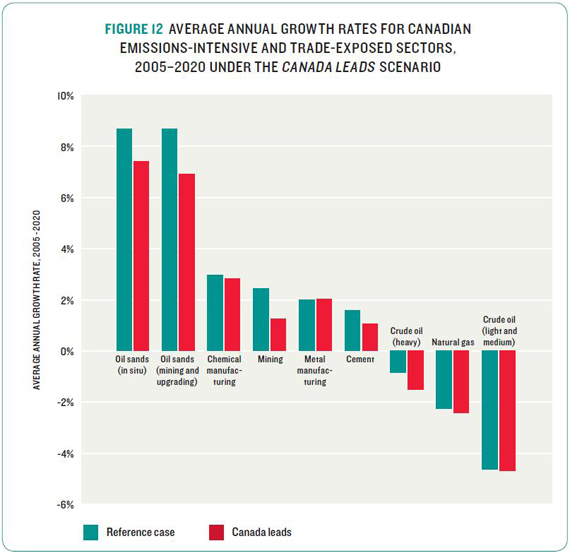
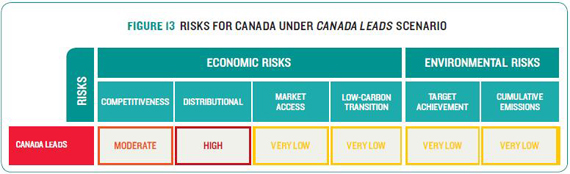
Figure 13 qualitatively summarizes our assessment of environmental and economic risks if Canada were to lead the U.S. on climate policy. Under the Canada Leads scenario, Canada would face moderate but real economic competitiveness risks. While national impacts of competitiveness on economic growth are likely to be small relative to the reference case, specific regions and sectors would bear the largest risk of economic impact, both from the costs of competitive disadvantage relative to the U.S. and from the costs of reducing emissions in Canada. Market access risks in the form of border carbon adjustments are eliminated in a Canada leads scenario. Unlike U.S. border carbon adjustments, a LCFS would have economic implications for Canada even if strong Canadian policy were implemented. However, Canadian climate policy could drive some improvements in the emissions intensity of the oil sands sector, thus sheltering it from impacts of an LCFS in the longer term. The risk associated with the costs of long-term reductions is lowered, placing Canada on a low-carbon transition path and positioning it to potentially develop and export new low-carbon technologies. Risks of not achieving GHG reduction targets are addressed as Canada takes steps to position itself for long-term GHG emission reductions.
[29] With 20% international offsets allowed.
[30] In this scenario, Canada implements a cap-and-trade system to achieve its 2020 target of 17% below 2005 levels, with 20% of its compliance coming from international permits. Permits to large emitters are allocated for free as output-based allocations. Both of these measures allow for some financial easing on firms. The rest of the economy is covered through an upstream cap with permit auction and revenue recycling 50% to corporate and 50% to income tax. The U.S. implements no policy, so has a carbon price of zero.
[31] This growth rate is consistent both with historical rates and other growth forecasts. See Canadian Association of Petroleum Producers (2010).
 © 2013