









6.0 Appendices – Facing the Elements
6.1 BARRIERS TO CANADIAN BUSINESS ACTION TO ADAPT TO CLIMATE CHANGE
Our research and convening activities over the course of one year revealed several factors standing in the way of business action.
Table 4 summarizes the ones most commonly raised by either businesses or industry associations. Our focus was on Canadian needs and challenges, yet the barriers that we highlight are striking in their similarity to those in the 2011 publication “Adapting for a green economy: companies, communities and climate change” by the United Nations Global Compact, United National Environmental Programme, Oxfam, and World Resources Institute. This hints at the broad applicability of these barriers and also of the opportunity for Canada to both learn from and contribute to public- and private-sector innovations worldwide, as markets for adaptation solutions mature.
Businesses can overcome a number of barriers internally (i.e., those in the column “direct business control”). The lack of top management commitment and support, competing priorities, and organizational culture are critically important but far from unique to climate change adaptation and so we skip these in our descriptions below.
TABLE 4
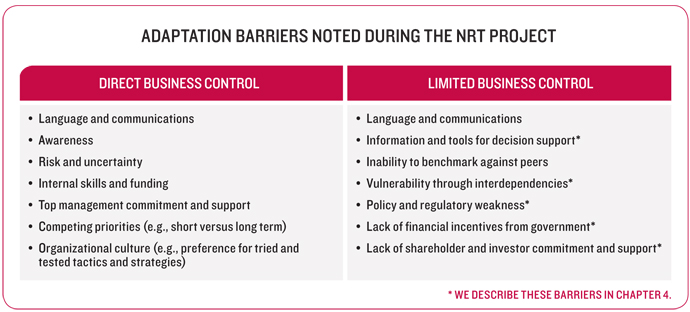
// LANGUAGE AND COMMUNICATIONS: Climate change adaptation is a vague term. And many still perceive climate change as an environmental issue. Business managers can increase the internal salience of adaptation by instead referring to specific operational risks related to preparing for severe weather risks or water availability risks, and also to strategic risks such as insurance affordability.
// AWARENESS (of the connection between risks of climate change and business objectives): Limited information and knowledge exists linking the impacts of climate change to businesses risks and opportunities. Available information is too seldom presented in a way that resonates with sector-specific business objectives. Though few businesses fully understand the risks they face as a result of future climate change, many are well aware of the business impacts of extreme events in the current climate (e.g., intense summer precipitation events), and can apply this knowledge as a first step. Several businesses profiled in this report noted the benefits of collaborative partnerships with academic researchers, specialist organizations, professional bodies, and others in similar industries, in increasing awareness and understanding of success factors for climate change risk assessment and adaptation planning.
// RISK AND UNCERTAINTY: Uncertainty around timing and magnitude of climate change impacts remains an impediment to adjusting core practices and business strategy in anticipation of future impacts. This is, in part, due to the perception that managing risks of climate change involves actions with high up-front costs and uncertain, long-term benefits. As a result, the case for action can be a hard sell, particularly with the use of discount rates. But, as examples in Chapter 3 demonstrate, adaptive measures can be inexpensive and implemented incrementally, reducing the need for high up-front costs. The businesses we profile in case studies treat uncertainty about future climate not as a barrier to decision making, but as just another uncertainty among the many they face in business planning.
// INTERNAL SKILLS AND FUNDING: Allocation of staff (expertise and time) and financial resources for climate change risk management is small and often inadequate. Because of wide-ranging consequences of climate change impacts, successful management of the issue requires a diverse skill set, and individuals with technical and management skills are too often overloaded with responsibilities. Collaboration among businesses and with umbrella groups like professional bodies and industry associations is an efficient approach to promoting the integration of climate change adaptation into standard business practices, and to aggregating demand for awareness-raising and education, and for tools or other resources to facilitate decision making.
Action by external parties to overcome barriers is also necessary (i.e., those listed under “limited business control” in Table 4) and these are the barriers we focus on in Chapter 4. The remaining two, “Language and communications” and “Inability to benchmark” merit a brief look:
// LANGUAGE AND COMMUNICATIONS: Industry associations, government departments and agencies and nongovernmental organizations will have more success in promoting adaptation to business audiences with a positive framing rather than a “doom and gloom” framing. Highlighting cost reductions anticipated from the adaptation initiative, or advantages gained relative to the competition, can both create a positive framing. Discussions on commercial and investment opportunities of climate change impacts and adaptation are long overdue in Canada. However, a positive, opportunities framing is not always effective — a prevention framing works well for some audiences (e.g., preventing legal liability). So, understanding sectoral and organizational cultures is an important early step when designing engagement strategies.120
// INABILITY TO BENCHMARK: A lack of best practices in managing climate change risks and of guidance on how to measure, communicate, and benchmark performance against peers are hurdles for businesses looking to adapt. Several reporting frameworks are available to help businesses communicate and disclose actions to manage risks from climate change, but their adoption is voluntary and patchy. As well, consensus is yet to emerge on key performance indicators for comparison within and across industry sectors.
6.2 TOOLKIT
Over the course of the NRT project on business resilience and adaptation to climate change, stakeholders mentioned the following information sources, tools to aid decision making, and other resources that are useful for businesses.
INFORMATION ON CLIMATE CHANGE, IMPACTS, AND ADAPTATION
Canadian Climate Change Scenarios Network: www.cccsn.ca
Climate trend analyses for 18 Canadian regions to 2050: www.iclr.org/images/Bruce_climate_change_info_march_2011.pdf
Intergovernmental Panel on Climate Change: www.ipcc.ch/index.htm
National Round Table on the Environment and the Economy: www.nrt-trn.ca
Natural Resources Canada Impacts and Adaptation website: www.nrcan.gc.ca/earth-sciences/climate-change/community-adaptation/54
Regional climate services: www.ouranos.ca; www.pacificclimate.org; www.parc.ca
The Nature Conservancy Climate Wizard: www.climatewizard.org
World Bank Climate Change Knowledge Portal: sdwebx.worldbank.org/climateportal/index.cfm
GUIDANCE, TOOLS, AND STANDARDS
Australian Government Climate Change Impacts & Risk Management: A Guide for Business and Government: www.climatechange.gov.au/community/~/media/publications/local-govt/risk-management.ashx
British Standards Institution: Climate Change Adaptation. Adapting to climate risks using ISO 9001, ISO 14001, BS 25999 and BS 31100: shop.bsigroup.com/en/ProductDetail/?pid=000000000030213386
Canadian Securities Administrators Environmental Reporting Guidance: www.osc.gov.on.ca/documents/en/Securities-Category5/csa_20101027_51-333_environmental-reporting.pdf
PIEVC Engineering Protocol for Climate Change Infrastructure Vulnerability Assessment: www.nrcan.gc.ca/earth-sciences/projdb/pdf/211_e.pdf
Shaping climate-resilient development: a framework for decision-making: mckinseyonsociety.com/downloads/reports/Economic-Development/ECA%20%20%20Shaping%20Climate%20Resilent%20Development%20%20%20Report%20Only.pdf
Standard CAN/CSA-ISO 14001-04 (R2009) — Environmental Management Systems - Requirements With Guidance for Use: shop.csa.ca/en/canada/environmental-management-systems/cancsa-iso-14001-04-r2009/invt/27002912004
Standard CAN/CSA-ISO 31000-10 — Risk management — Principles and guidelines: shop.csa.ca/en/canada/risk-management/cancsa-iso-31000-10/invt/27030372010
Standard CAN/CSA-ISO 9000-05 (R2010) — Quality Management Systems — Fundamentals and Vocabulary: shop.csa.ca/en/canada/quality-assurance-and-quality-management/cancsa-iso-9000-05-r2010/invt/27012042005
UKCIP Climate adaptation: Risk, uncertainty and decision-making: www.ukcip.org.uk/wordpress/wpcontent/PDFs/Risk.pdf
United Kingdom Climate Impacts Programme (UKCIP) Business Areas Climate Assessment Tool (BACLIAT): www.ukcip.org.uk/bacliat
INSTITUTIONAL NETWORKS
Canadian Centre for Emergency Preparedness (CCEP): www.ccep.ca
Carbon Disclosure Project: www.cdproject.net/en-US/Pages/HomePage.aspx
United Nations Framework Convention on Climate Change Adaptation Private Sector Initiative: unfccc.int/adaptation/nairobi_work_programme/private_sector_initiative/items/4623.php
FINANCIAL INCENTIVES
Canada Revenue Agency Scientific Research and Experimental Development (SR&ED) tax incentive program: www.cra-arc.gc.ca/txcrdt/sred-rsde/menu-eng.html Sustainable Development Technology Canada SD Tech Fund: www.sdtc.ca/index.php?page=sdtechfunding-niche&hl=en_CA
6.3 STAKEHOLDER ENGAGEMENT
STAKEHOLDER SCOPING SESSION
This meeting took place on June 3, 2011, and considered how the NRT could best contribute to advancing private sector adaptation through its work on business resilience in a changing climate.
Elizabeth Atkinson Manager-Policy, Climate Change Impacts and Adaptation Natural Resources Canada Darren Brown Senior Policy Advisor Cement Association of Canada Bruce Burrows Vice-President of Public & Corporate Affairs Railway Association Canada Nicholas Cheung National Practice Leader - Sustainability Canadian Institute of Chartered Accountants Darrel Danyluk Chair World Federation of Engineering Organizations Committee on Engineering and the Environment Blair Feltmate Professor and Director, Sustainability Practice University of Waterloo Dave Finlayson Vice President, Science and Risk Management Canadian Fertilizer Institute David Foster Director, Environmental Affairs Canadian Home Builders’ Association John Gamble President Association of Consulting Engineering Companies Ed Gregory Manager, Research and Analysis Brewers Association of Canada Jim Hughes Canadian Association of Petroleum Producers Manager, Energy Analysis, Imperial Oil Don Johnston Senior Director, Policy and Technical Research Canadian Home Builders’ Association Pam Laughland Managing Coordinator Network for Business Sustainability Don McCabe Vice President Ontario Federation of Agriculture Thibaut Millet Conseil patronal de l’environnement du Québec Chef d’équipe, Changements climatiques et développement durable, Ernst & Young Michael Mortimer Program Manager, Built Environment Standards Canadian Standards Association Matt Parry Executive Director, Policy Development Environment Canada Paul Steenhof Project Manager, Climate Change Issues Canadian Standards Association Michelle Turner Manager, Environmental Stewardship Canadian Electricity AssociationTHE BOTTOM LINE ON MANAGING CLIMATE CHANGE RISKS AND OPPORTUNITIES: A FORUM FOR FINANCIAL EXECUTIVES
This meeting hosted by the NRT and the Network for Business Sustainability took place on October 27, 2011, to explore the business case for action to manage and adapt to the impacts of climate change.
Elizabeth Atkinson Manager-Policy, Climate Change Impacts and Adaptation Natural Resources Canada Andrea Baldwin Associate Principal SECOR Tima Bansal Executive Director Network for Business Sustainability Ian Bragg Associate Director, Research, Policy & Institutional Services Social Investment Organization Sherri Brillon Vice President & Chief Financial Officer EnCana Corporation Nicholas Cheung National Practice Area Leader – Sustainability Canadian Institute of Chartered Accountants Michael Conway Chief Executive & National President (Toronto Chapter) Financial Executives International Canada John Coyne Vice President & General Counsel Unilever Canada Inc. Julie Desjardins Advisor Canadian Institute of Chartered Accountants Blair Feltmate Professor and Director, Sustainability Practice University of Waterloo Eleanor Fritz Director, Compliance & Disclosure Toronto Stock Exchange Brian Kelly Interim Advisor, Climate Change Office of the CAO Region of Durham Matthew Kiernan Chief Executive Officer Inflection Point Capital Management Patricia Koval Partner Torys LLP Gordon Lambert Vice-President Sustainable Development Suncor Energy Inc. Pam Laughland Knowledge Director Network for Business Sustainability Leslie Markow Chief Financial Officer Solutions4CO2 Inc. Jo-Anne Matear Assistant Manager, Corporate Finance Ontario Securities Commission Doug Morrow Senior Associate ICF Marbek Kathleen O’Neill Manager, Strategic Policy Ontario Ministry of Environment Sandra Odendahl Director, Corporate Environmental Affairs Royal Bank of Canada Robert Slater NRT Vice-Chair Adjunct Professor, Environmental Policy Carleton University Barb Steele Director, Strategic Partnerships Network for Business Sustainability Gregor Robinson Senior Vice-President, Policy Chief Economist Insurance Bureau of Canada Jason Thistlethwaite Project Manager – Climate Change Adaptation Project University of Waterloo Barbara Turley-McIntyre Director, Sustainability and Corporate Citizenship The Co-operators Group Ltd Bob Willard Author & Speaker The Sustainability Advantage Jeffrey Williams Director of Climate Consulting Entergy Corporation Laura Zizzo Partner Zizzo Allan Climate Law LLPLEVERAGING INVESTMENTS IN CLIMATE SCIENCE AND IMPACTS AND ADAPTATION RESEARCH TO SUPPORT BUSINESS RESPONSES TO CLIMATE CHANGE TODAY
A two-part webinar series (November 22 and December 15, 2011) hosted by the NRT and The Delphi Group explored new ways to collaborate within and across private and public sectors to turn data, information, and knowledge into action.
Chris Adachi Leader, Energy and Carbon Management Teck Cominco Ltd. Jean-Christophe Amado Risk Manager Acclimatise North America Jim Barnes Manager, Corporate Initiatives BC Ministry of Transportation and Infrastructure Jim Bruce Environmental Consultant Alain Bourque Director – Impacts and Adaptation Ouranos Consortium Paul Cobb Senior Technical and Policy Advisor Pembina Institute for Appropriate Development Heather K. Coleman Senior Policy Advisor, Climate Change Oxfam America Julie Desjardins Advisor Canadian Institute of Chartered Accountants Claude Desjarlais Director of Economic Analysis Ouranos Jenny Dissen Director of the Summer Institute on Climate Change U.S. National Climatic Data Center Mark Egener President Summit Enterprises International, Inc. Jack Fitzsimmons Global Knowledge Manager Marsh Risk Consulting Marie Hanquez Sustainability Specialist Alcoa James Hudson Climate Change Adaptation Specialist Climate Change Secretariat, Government of New Brunswick Danielle Jmieff Business Development Analyst Climate Action Secretariat, Ministry of Environment Government of British Columbia Sonia Lacombe Director – Climate Change Rio Tinto Alcan Inc. Don Lemmen Research Manager Climate Change Impacts and Adaptation Division, Natural Resources Canada Hans Luu EnCana Corporation Michael Mortimer Program Manager, Built Environment Standards Canadian Standards Association Trevor Murdock Lead, Regional Climate Impacts Pacific Climate Impacts Consortium Sarah Ozog Climate Action Technician District of Saanich Joe Rogers Director, Research and Technology Services The Delphi Group Dave Schwass Senior Advisor Nova Chemicals Ryan Schwartz Senior Policy Analyst, Policy Development Environment Canada Chandra Sharma Watershed Specialist and Senior Manager Climate Programs Toronto and Region Conservation Benoit Sicotte Associate Director, Corporate Responsibility and Environment Bell Canada Stephen Skarstol Lead, Environmental Stewardship EnCana Corporation Lise Sylvain Regional Sustainability Manager Alcoa Jason Thistlethwaite Project Manager – Climate Change Adaptation Project University of Waterloo Ian Turpin Advisor Environment & Corporate Social Responsibility Bell Canada Fiona Warren Research Program Officer Climate Change Impacts and Adaptation Division Natural Resources Canada John Van Ham Manager, Environmental Stewardship, Environment and Sustainable Development ConocoPhillipsBUILDING BUSINESS RESILIENCE IN A CHANGING CLIMATE: A PATH FORWARD FOR BUSINESS AND GOVERNMENT
This meeting took place on January 24, 2012, to seek advice on the direction, focus, and urgency of actions by government, industry, and other stakeholders to position Canada’s private sector to adapt and prosper in a changing climate.
Jean-Christophe Amado Risk Manager Acclimatise North America Elizabeth Atkinson Manager-Policy, Climate Change Impacts and Adaptation Natural Resources Canada Bruce Burrows Vice-President of Public & Corporate Affairs Railway Association Canada Paul Cobb Senior Technical and Policy Advisor Pembina Institute for Appropriate Development Julie Desjardins Advisor Canadian Institute of Chartered Accountants Arthur DeJong Mountain Planning and Environmental Resource Manager Whistler Blackcomb Claude Desjarlais Director of Economic Analysis Ouranos Susan Evans Advisor, Conservation Science World Wildlife Fund (WWF) – Canada David Greenall Senior Manager and Ottawa Practice Leader Deloitte & Touche LLP Fiona Jones Director of Energy & Climate Change Policy Suncor Energy Inc. Sonia Lacombe Director – Climate Change Rio Tinto Alcan Inc. Pamela Laughland Managing Director Network for Business Sustainability Sandra Odendahl Director, Corporate Environmental Affairs Royal Bank of Canada Kathleen O’Neill Manager, Strategic Policy Ontario Ministry of Environment Robert Page TransAlta Professor of Environmental Management and Sustainability University of Calgary Gordon Peeling Independent Consultant Ryan Schwartz Senior Policy Analyst, Policy Development Environment Canada Marjorie Shepherd Director, Climate Research Division Environment Canada Robert Slater NRT Vice-Chair Adjunct Professor, Environmental Policy Carleton University Jason Thistlethwaite Project Manager – Climate Change Adaptation Project University of Waterloo Michelle Turner Director, Generation & Environment Canadian Electricity Association Georgina Wainwright Kemdirim Manager, Policy Development Sustainability and CSR Strategic Policy Branch Industry Canada Euan Wallace First Secretary, Head of Global Issues Group British High Commission Adrienne Yuen Climate and Prosperity Advisor, Global Issues Group, British High CommissionNRT ADVISORY COMMITTEE
Advisory committee members participated in four teleconferences between August 2011 and January 2012 to provide advice and feedback on the project.
Elizabeth Atkinson Manager-Policy, Climate Change Impacts and Adaptation Natural Resources Canada Alain Bourque Director – Impacts and Adaptation Ouranos Consortium Kim Brand Director of Environmental Affairs Scotiabank Bruce Burrows Vice President, Public and Corporate Affairs Railway Association of Canada Susan Evans Advisor, Conservation Science WWF-Canada Julie Desjardins Advisor Canadian Institute of Chartered Accountants Blair Feltmate Professor and Director, Sustainability Practice University of Waterloo John Gamble President Association of Consulting Engineering Companies Sonia Lacombe Director - Climate Change Rio Tinto Alcan Pam Laughland Knowledge Director Network for Business Sustainability David Marshall Executive Director Fraser Basin Council Paul Cobb Senior Technical and Policy Advisor Pembina Institute Robert Page TransAlta Professor of Environmental Management and Sustainability University of Calgary Matt Parry Executive Director Environment Canada Alternate: Ryan Schwartz Senior Policy Analyst Gordon Peeling Independent Consultant Jason Thistlethwaite Project Manager University of Waterloo Janos Toth Project Manager – R&D BC Hydro Robert Tremblay Director of Research Insurance Bureau of Canada © 2013