







Annual Report 2011-2012 – The Year in Review
During the 2011-2012 fiscal year, the National Round Table on the Environment and the Economy (NRTEE) continued to develop policy advice on issues that lie at the intersection of the environment and the economy, building from a sound foundation of research and stakeholder convening. Four NRTEE advisory reports were released over the year.
The NRTEE also undertook an initiative to renew its corporate brand, emphasized the role of the NRTEE as a convener that creates the context in which possibilities can emerge, building pathways to sustainability. The launch of a new and improved NRTEE website was a key element of this branding initiative.
1.1 FROM RESEARCH AND CONVENING TO ADVISORY REPORTS
Over the 2011-2012 fiscal year, the NRTEE continued to make contributions in three key policy areas:
- The economic risks and opportunities of climate change;
- Water sustainability and Canada’s natural resource sectors; and
- Review of the Government of Canada’s implementation of the Kyoto Protocol.
CLIMATE PROSPERITY – THE ECONOMIC RISKS AND OPPORTUNITIES OF CLIMATE CHANGE FOR CANADA
Building on its previous work on climate change, the NRTEE launched its Climate Prosperity program in 2009–2010, focusing on the economic risks and opportunities for Canada related to climate change.
Climate Prosperity is a multi-year policy initiative focusing on two principal research streams:
- The economic implications to Canada resulting from a changing climate, how we should adapt to it, and what this will cost.
- The economic implications to Canada resulting from a global transition to a low-carbon economy, what this means to our future competitiveness, and what strategies we should adopt to succeed.
Efforts in 2011-2012 focused on the three final projects in the Climate Prosperity series which explored the following themes: the economic costs of climate change for Canada, building business resilience in a changing climate, and transitioning to a low-carbon economy.
The following Climate Prosperity publications were issued in 2011-2012:
Paying the Price: The Economic Impacts of Climate Change for Canada
This report estimates the economic consequences of climate change for Canada. In addition to generating high-level estimates of the costs of climate change for the country as a whole, the report also assesses the costs of climate change impacts and the costs and benefits of adaptation for three areas of interest: timber supply, coastal areas, and human health. It concludes that climate change impacts brought about by increased world-wide emissions have a real and growing economic cost to Canada: $5 billion in 2020 and between $20 and $43 billion in 2050 It also shows that adaptation – our capacity to manage the impacts to come – while not cost-free, is a costeffective way to alleviate some of those impacts.
Following the release of this report, NRTEE staff conducted stakeholder outreach, expanding our use of webinars to engage in dialogue with a national audience. The NRTEE also presented the report findings to public servants in the Government of Ontario through the government’s Policy Forum series.
Facing the Elements: Building Business Resilience in a Changing Climate
Facing the Elements is a three-report series advising business and governments on coping with climate change from a business perspective. The effects of more volatile weather and gradual changes in climate conditions will touch all facets of Canadian business in the decades to come. Despite growing awareness of the risks and opportunities that changing climate presents, few firms are adjusting business strategies and practices to adapt to this inevitable reality. The NRTEE researched several emerging issues for this project including building climate change resilience across the supply chain, assessing corporate disclosure of climate change-related risks, and protecting the resilience of critical infrastructure. In addition, the NRTEE engaged with stakeholders to explore the business case for adaptation, discuss climate change information needs to inform decision-making, and identify priorities for government action to support private sector adaptation.
The Case Studies offer a collection of company case studies presenting successes, challenges, and lessons from thirteen Canadian and international pacesetters who are already adapting to climate change by assessing and managing risks and opportunities and building climate resilience across their enterprises. The Business Primer provides business-friendly information about the adaptation imperative and practical steps firms can take to get in front and succeed in the face of this growing challenge. The Advisory Report includes research findings and recommendations on how government can support greater business adaptation to climate change.
Forthcoming Climate Prosperity Reports
Work also continued on the NRTEE’s Climate Prosperity initiative aimed at developing a low-carbon growth plan for Canada. During 2011-2012, the NRTEE engaged extensively across the country to hear regional perspectives on this project. Quantitative and qualitative research was also undertaken to identify opportunities and challenges in making the transition to a low-carbon economy, particularly in relation to energy, innovation, trade, skills, investment, and governance.
Copies of the published reports, as well as more information on the Climate Prosperity program can be found at http://nrt-trn.ca/climate/climate-prosperity
CHARTING A COURSE: SUSTAINABLE WATER USE BY CANADA’S NATURAL RESOURCE SECTORS
The NRTEE program on Water Sustainability and Canada’s Natural Resource Sectors released a first report, Changing Currents: Water Sustainability and the Future of Canada’s Natural Resource Sectors, in 2010-2011. This report looked at the current state of water use by Canada’s natural resource sectors and identified key issues. During 2011-2012, a second phase of this program focused on developing information and advice to ensure the sustainable use of water by the resource sectors. The approach included commissioning research and analysis from some of Canada’s top water experts and conducting extensive stakeholder engagement to inform report scoping, test the research findings, identify potential solutions, and solicit feedback on preliminary conclusions. The report, Charting a Course: Sustainable Water Use by Canada’s Natural Resource Sectors, included recommendations in the areas of water forecasting, water quantity data and information, collaborative water governance, and policy instruments.
In January 2012, the NRTEE convened a National Water Forum with 50 Canadian water experts, government representatives, academics, and industry representatives to further refine the report recommendations and move towards implementation. Participants from across the country discussed, deliberated on, and ranked the recommendations in Charting a Course, suggesting ways to move the recommendations from argument to action. In addition, participants identified organizations or groups that might be able to lead or contribute to moving the recommendations forward. This innovative and high-profile convening event was webcast live across the country, and the 50 experts in the room were supplemented by an additional 100 online participants. The webcast was recorded and is now available on the NRTEE website along with a summary report that provides the start of an action plan that will make important contributions to the management and governance of Canada’s water resources.
Information on the Water Sustainability and Canada’s Natural Resource Sectors can be found at http://nrt-trn.ca/water/water-sustainability-and-the-future-of-canadas-natural-resource-sectors-2
KYOTO PROTOCOL IMPLEMENTATION ACT
The Kyoto Protocol Implementation Act (KPIA) was passed by Parliament in June 2007 and calls on Canada to meet its international commitment under the Kyoto Protocol by reducing greenhouse gas emissions to six per cent below 1990 levels by 2012. Every year, the government must prepare a Climate Change Plan describing the measures and policies it enacted to ensure that Canada meets its obligations under the Protocol. This plan must also detail the expected emission reductions resulting from the government’s measures and policies.
Subsection 10(1) of the KPIA requires the NRTEE to
- Undertake research and gather information and analyses on the Plan or statement in the context of sustainable development; and
- Advise the Minister on issues that are within its purpose, including the following:
- The likelihood that each of the proposed measures or regulations will achieve the emission reductions projected in the Plan or statement;
- The likelihood that the proposed measures or regulations will enable Canada to meet its obligations under Article 3, paragraph 1, of the Kyoto Protocol, and
- Any other matters that the Round Table considers relevant.
The NRTEE undertook the required analysis to comply with our obligations under the KPIA and our findings were provided on July 28th in our fifth written response to the Minister of the Environment: Response of the National Round Table on the Environment and the Economy to its Obligations under the Kyoto Protocol Implementation Act, July 2011. The report highlights improvements in the transparency of the plan, including methods to estimate emission reductions from policy measures. It also notes improved reliability of some estimates and the publication of emissions projected out to 2020 under both a reference case and the policy scenarios. The NRTEE concluded that the forecasts provided by the integrated modeling in the plan are reliable.
Further areas for improvement were also identified:
- Concerns remain about the additionality of emission reductions driven by policy measures;
- Some of the assumptions used to develop the reference case should be further substantiated, as the current assumptions may result in overestimates of projected emission reductions for some policy measures; and
- There would be value in extending the time horizon of the evaluation to assess expected emission reductions out to 2020.
This will be our final KPIA report, as the government has repealed the KPIA under bill C-38, the Jobs, Growth and Longterm Prosperity Act. Copies of the NRTEE’s most recent KPIA report can be found at http://nrt-trn.ca/governance/kyoto- protocol-implementation-act/kpia-2011-index
MINISTERIAL REFERENCES
In March 2011, the Honourable Peter Kent, Minister of the Environment, requested that the NRTEE provide advice to the Government of Canada relating to provincial and territorial climate change plans and policies, and potential life cycle approaches to enhance environmental sustainability.
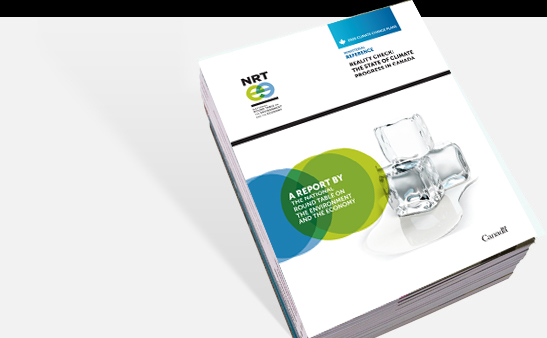
REALITY CHECK: THE STATE OF CLIMATE PROGRESS IN CANADA
The NRTEE conducted original research and engaged with stakeholders to conduct a comprehensive assessment of provincial/ territorial climate change plans and policies in order to better inform federal actions aimed at meeting Canada’s 2020 greenhouse gas emissions reduction target. The research included quantitative modeling of the expected emission reductions from existing and proposed climate policies at the federal and provincial/territorial level alongside an assessment of the cost effectiveness of emission reduction actions. The NRTEE engaged heavily with the provinces and territories in the development of this analysis, and brought together officials from the federal and provincial/territorial governments, several NRTEE Members, climate public policy experts, and intergovernmental experts in Kingston, Ontario at an event organized by the NRTEE, in conjunction with the Queen’s University Institute of Intergovernmental Relations. The purpose of the event was to present the NRTEE’s early research findings; engage in a dialogue on the issues raised by the assessment; and invite advice on the path forward.
The report includes the results of the research and convening activities, including a qualitative and quantitative assessment of existing plans. It shows that Canada is making significant progress toward its 2020 target but will not get there with only existing and proposed climate policy measures by all governments. The report also offers advice on what instruments and mechanisms should be explored further in Canada as climate policy evolves. The NRT recommends that advances in future Canadian climate policy meet three tests: that they are collaborative, coherent, and considered. In addition, the NRT recommends complementing the federal sector-by-sector regulatory approach with base-level carbon pricing; announcing a detailed plan as to which sectors will be regulated and when; using equivalency agreements with provinces for flexibility; and conducting regular independent forecasts of anticipated progress in reducing emissions.
The Report may be found at http://nrt-trn.ca/reality-check-the-state-of-climate-progress-in-canada.
CANADA’S OPPORTUNITY: ADOPTING LIFE CYCLE APPROACHES FOR SUSTAINABLE DEVELOPMENT
In developing this report, the NRTEE’s research explored the drivers, risks, opportunities, and challenges related to the uptake of life cycle approaches in Canada. It investigated these issues in the context of the private sector and presented recommendations on how the Government of Canada could support the uptake of life cycle approaches by Canadian businesses. It also explored these issues related to internal federal operations and decision-making processes and identified recommendations for Government of Canada action within key departments. The NRTEE convened more than 100 experts and stakeholders over seven sessions to guide the research for this report, comment on the findings and contribute to the recommendations.
The report identifies the risks faced by Canadian companies to comply with increasing foreign government regulations and emerging market demands that require product life cycle disclosure and stronger environmental standards. It concludes that applying life cycle approaches could enhance economic competitiveness and environmental stewardship of our resources and in design, production, and consumption of goods and materials. The report offers advice and recommendations to help the Government of Canada assess how life cycle approaches could contribute to long-term sustainability in Canada and the role the government could play to facilitate successful uptake of life cycle approaches within government and in the private sector. In particular, it recommends that the federal government build its internal understanding of life cycle issues, help Canadian companies maintain access to foreign & domestic markets, proactively engage in discussions on issues related to life cycle approaches, and show leadership in the application of life cycle approaches to internal operations & policy decision making.
The Report may be found at http://nrt-trn.ca/canadas-opportunity.
1.2 CORPORATE MANAGEMENT INITIATIVES
Renewing the NRTEE Brand
This year the NRTEE implemented an initiative to clearly articulate the organization’s strategic positioning and brand and adjust our communications approach accordingly. The initiative established the following three communications objectives: (1) entrench the NRTEE’s relevance among decision makers; (2) present the NRTEE as one of Canada’s most impactful organizations on issues related to environment and economy, and (3) position the NRTEE as an organization with reach, capable of generating consensus and an organization with something to say. With the positioning statement ‘Finding sustainable pathways’, the NRTEE’s emphasizes the high quality of research it provides and its unique convening power on matters related to the environment and the economy, the sum of which is strong, impartial advice to governments.
A key component of this strategy was an overhaul of the NRTEE’s website which presents the wealth of information developed by the NRTEE in an engaging and accessible manner. The organization has also provided more regular updates on its activities through profiling stakeholder events and sharing associated documentation, allowing stakeholders and partners to stay apprised of NRTEE work and developments prior to the publication of final reports.
Greening the NRTEE
The NRTEE continued to green our operations and raise employee awareness on a range of environmental issues. Highlights of the activities organized by the NRTEE’s Green Steering Committee in 2011-2012 include:
- During the summer of 2011, the NRTEE conducted a two week commuter challenge that encouraged employees to reduce the environmental impact of their commuting patterns. This challenge let staff trade commuting permits through a cap and trade system, helping staff better understand an environmental policy instrument and encouraging more sustainable transportation choices.
Member Engagement
Members of the NRTEE continued to make contributions to the work of the organization through their participation in the plenary meetings and stakeholder convening events. One highlight in 2011-2012 was the NRTEE plenary meeting held in Halifax, Nova Scotia. This meeting included a panel discussion on the Lower Churchill Hydroelectric Project and site visits to Minas Basin Pulp and Power Company Ltd and the Irving Environmental Centre at Acadia University. Members played important roles in several NRTEE convening events, including the Water Forum and a Canadian Climate Policy Dialogue session held in Kingston with the Queen’s University Institute for Intergovernmental Relations.
1.3 CORPORATE MANAGEMENT INITIATIVES
Over the past fiscal year, our communications and public affairs activities have focused on supporting the release of NRTEE reports and re-positioning the organization, developing associated communications products and strategies, and establishing a new website for the organization.
In September 2011 the NRT released a fresh new look and structure for its website (www.nrt-trn.ca). This new design helped to solidify the NRT’s strategic position as one of Canada’s most impactful organizations on issues related to environment and economy, while making the brand pillars of research, convene, and advise more tangible. The site’s new architecture and social media components offer a better and more intuitive user experience, and in turn allow the NRT to extend its reach.
During the 2011-2012 fiscal year, there were 380,000 visitors to the website. In addition to the website, we expanded our web presence though participation in Twitter and other social media channels. This allowed the NRTEE to extend our reach to more than 30,000 people with the release of each NRTEE report.
Media Outreach and Presence
The NRTEE’s engagement with media continued to grow in 2011-2012, with high levels of attention surrounding the release of various NRTEE reports. The NRTEE experienced its greatest media attention to date with the release of Paying the Price: The Economic Impacts of Climate Change for Canada. More than 700 media stories (print, radio, and television) followed the release of this report. The release of Charting a Course: Sustainable Water Use by Canada’s Natural Resource Sectors also attracted significant attention, with 160 media stories, as did the related stakeholder meeting convened to discuss a path forward.
Promoting NRTEE Advice
Promoting the research and policy advice of the Round Table is essential to raising awareness and influencing government. The NRTEE promotes its advice through media relations, its website, direct electronic distribution to stakeholders, as well as by undertaking outreach activities, speaking engagements, and collaborative activities with non-governmental sectors, stakeholders, academia, and other organizations. Each targeted audience and activity is critical to the agency’s efforts to reinforce its acknowledged reputation as a credible and trustworthy source of research and advice.
Report Download Statistics:
Electronic publishing has helped to extend the NRTEE’s outreach to its stakeholders and reduce the number and cost of hard-copy reports. Access to publications via the website has not only permitted immediate access to our stakeholders, it has significantly increased the distribution levels.
| REPORTS | Downloads to June 30, 2012 |
|---|---|
| Reality Check: The State of Climate Progress in Canada | 6,856 |
| Canada’s Opportunity: Adopting Life Cycle Approaches for Sustainable Development | 4,326 |
| Facing the Elements (3 report series - Advisory Report, Business Primer, and Case Studies) |
7,612 |
| Charting a Course: Sustainable Water Use by Canada’s Natural Resource Sectors and Moving to Action: NRT National Water Forum Report | 5,178 |
| Paying the Price: The Economic Impacts of Climate Change for Canada | 9,640 |
| Parallel Paths – Outreach report | 523 |
 © 2013